20,700+ NGOs Lose Foreign Funding Since the 2020 FCRA Amendment
On average, 12 organisations were deregistered every day over five years. What the amendments changed, and who they hit hardest.

What Is FCRA?
The Foreign Contribution (Regulation) Act, 2010 regulates how NGOs in India receive and use foreign donations. Its stated aim is to prevent the misuse of foreign funds and safeguard national interest. India has over 30 lakh registered NGOs, playing a vital role in achieving Sustainable Development Goals.
The Key Changes Introduced in 2020
The Government of India passed the FCRA Amendment Bill, 2020 on 23 September 2020, with little prior consultation. It brought significant changes: a ban on sub-granting, meaning recipient NGOs can no longer transfer foreign funds to other, often smaller organisations; a reduced administrative expense cap, cut drastically from 50% to 20%; and a mandatory SBI account, requiring all foreign contributions to be received through a designated FCRA account at the State Bank of India's main branch in New Delhi.
A 'Reductive' View of Rights
On 8 April 2022, the Supreme Court upheld the constitutionality of the 2020 amendments, asserting that NGOs "do not have a fundamental right to receive foreign funds," and that foreign contribution can have material impact on the socioeconomic structure and polity of the country.
Advocate-on-Record Abhishek Jebaraj notes that the Court's framing of questions related to fundamental rights is "dangerously reductive of their true scope," and that this is troubling.
Stifling the Grassroots
The ban on sub-granting severely impacts smaller, grassroots organisations. As Ingrid Srinath, Director of CSIP, explains, "It is smaller grassroots organisations that rely on re-granted money. They lack the wherewithal to access international donors directly."
Without sub-grants, NGOs serving minority communities will have to reduce the strength of their grassroots workers, potentially reversing progress on Sustainable Development Goals. The amendment makes collaboration and consortiums nearly impossible.
The reduction of the administrative expense cap to 20% is proving challenging, because FCRA's definition of administrative expense is broad. As Ms. Srinath argues, "You cannot run a field programme without layers of supervision, management, policy design and strategy. Effectively, the Amendments suggest that those organisations must fund all costs from domestic donors. This makes it near impossible for certain types of work to happen at all."
It is smaller grassroots organisations that rely on re-granted money. They lack the wherewithal to access international donors directly.
— Ingrid Srinath, Director, CSIP
Transparency, or Control?
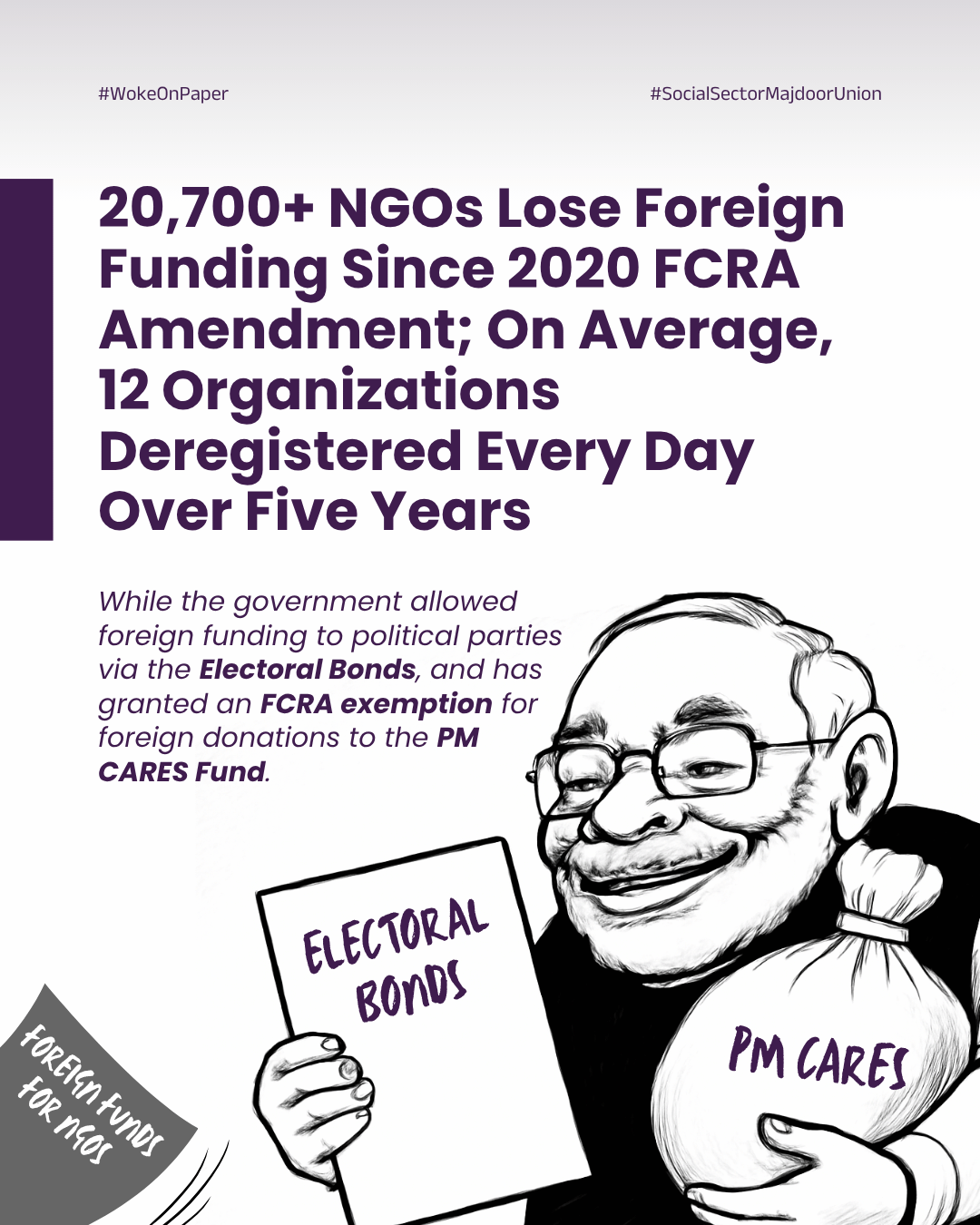
The government claims the amendments enhance transparency. But critics point to contradictions: electoral bonds permitted political contributions from international entities via an "entirely opaque" instrument; the PM CARES Fund accepts international donations but "is not subject to any scrutiny."
Between 2020 and 2025, 20,700 NGOs had their FCRA licenses cancelled. Lawyer Aditya Shrivastava suggests many cancellations were due to "mere technicalities, such as failure to file annual returns on deadline," rather than genuine misuse.
The Union government argued that foreign donations doubled between 2010 and 2019, raising the risk of foreign interference and alleged use for "Naxalite and other activities." However, there is no publicly available data to show the purported magnitude of misuse, raising questions about whether the strict limitations are proportionate to the supposed threat.
The Gaps in Domestic Giving
While domestic funding is increasing, it comes with limitations. CSR law is designed to incentivise short-term, easy-to-measure service delivery. Domestic philanthropy prioritises sectors like health and sanitation (₹6,916.66 crore), education (₹6,463.51 crore) and rural development (₹1,671.45 crore) for FY2020-21.
Neglected causes suffer: NGOs working with marginalised groups such as HIV-AIDS patients, unorganised labour, persons with disabilities, and commercial sex workers are "not popular with Indian donors." This leaves crucial social justice work vulnerable.
A Call for Dialogue and Reform
To mitigate the negative impacts, a more balanced approach is needed: a robust grievance redressal mechanism so NGOs aren't forced into tiresome legal battles; clearer guidelines to reduce ambiguity in "category matching" that delays registration; support for a domestic philanthropy ecosystem oriented towards long-term institutional strengthening, not just short-term programmes; and genuine dialogue with civil society, given the initial bill was passed "without any prior consultation."
The shift towards domestic funding, while positive in some aspects, cannot fully compensate for the specialised funding and operational support that foreign contributions often provide — particularly for less popular causes. A critical re-evaluation is crucial to ensure that regulation does not inadvertently hinder the vital role NGOs play in India's development.
WokeOnPaper is an independent satire media collective led by a small group of development practitioners. Through memes, stories and commentary, it reflects on the everyday absurdities of the social sector — nudging it towards becoming more honest, participatory and democratic.