How Government and Public Narratives Shape Which NGOs Are Allowed to Exist
An excerpt from the EU System for an Enabling Environment for Civil Society (EU SEE) report on India, 2025.
A Polarised Political Culture
The political culture surrounding civil society is increasingly polarised, with a thin and often blurred line between political activism and the legitimate role of civil society organisations. CSOs have historically contributed to social reform, development and public accountability. But in recent years, their work is often portrayed — particularly in political rhetoric and some sections of the media — as politically motivated or aligned with "anti-national" elements.
How the Narrative Is Amplified
This narrative is amplified through certain sections of the media and digital platforms. Mainstream, pro-government media outlets frequently echo official rhetoric, portraying critical voices in civil society as enemies of the state. Terms like "urban naxal" have been used to discredit dissenters, reinforcing suspicion and hostility.
In contrast, a few independent digital media platforms continue to highlight the value of civil society and expose unlawful state actions — but they face increasing legal and digital pressure themselves.
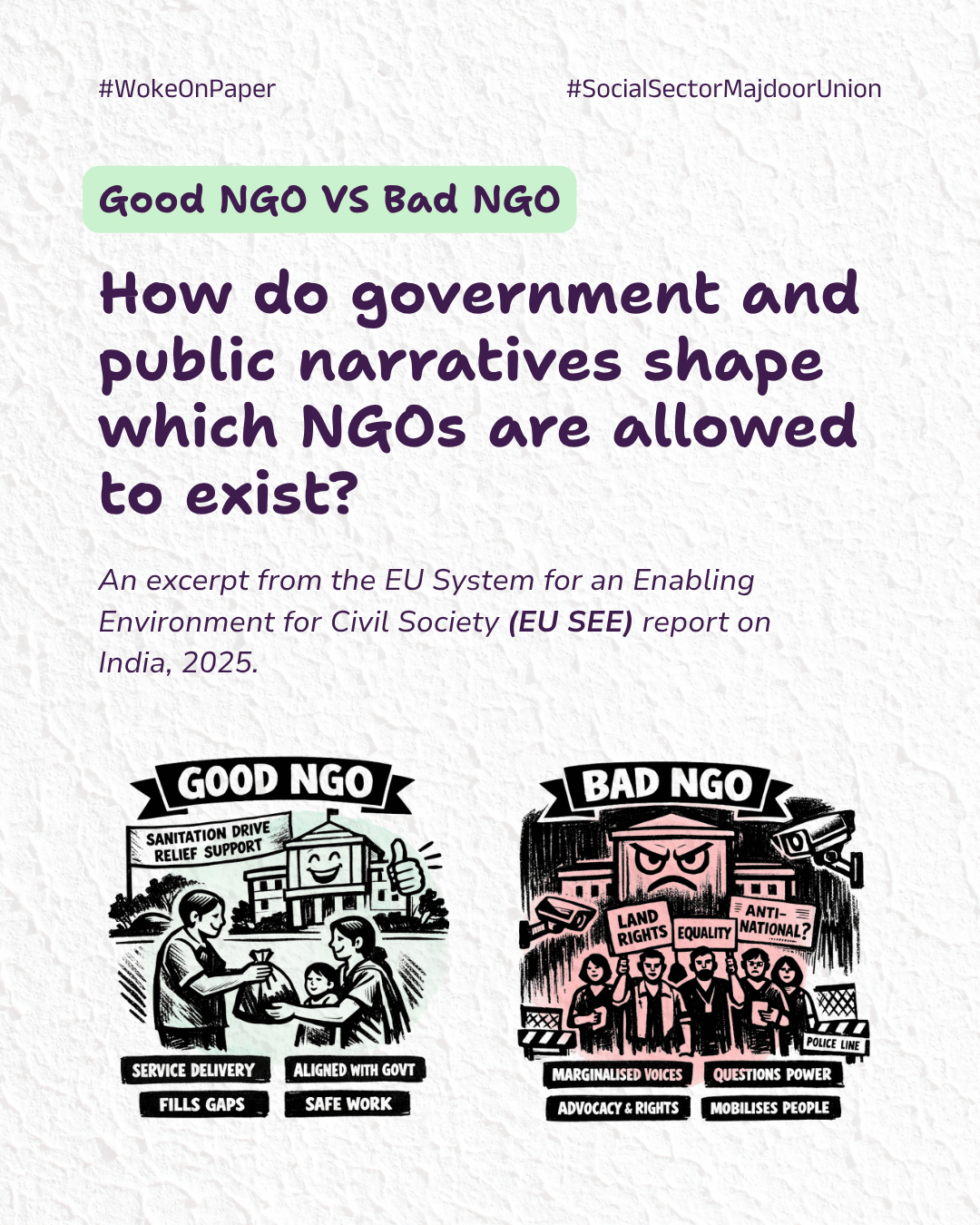
The 'Good NGO' vs 'Bad NGO' Divide
Not all CSOs face the same treatment. Organisations focused on service delivery — sanitation, education, disaster response — are often praised and welcomed, especially when aligned with government programmes. This creates a clear distinction between "acceptable" and "unacceptable" civil society work, determined less by legality and more by political alignment.
A "good NGO," in this framing, fills gaps where the government is absent, avoids questioning policy or structural inequality, aligns with government schemes, and is perceived as "helping," not "organising." A "bad NGO" works with Dalits, Adivasis, Muslims, LGBTQ+ communities or other socially excluded groups; focuses on rights, advocacy and dissent; challenges state actions or exposes unlawful practices; and uses the language of justice, equity and accountability — which is then framed as "political."
Why This Matters
As a result, CSOs that engage in advocacy or work with marginalised populations frequently face barriers to funding, registration and public legitimacy.
Public attitudes are mixed. In many communities, CSOs are valued for their service where the state is absent. But broader public understanding of advocacy and rights-based work remains limited and easily influenced by dominant political narratives. Organisations supporting Dalits, Adivasis, Muslims and LGBTQ+ rights often encounter both state and societal resistance, reflecting wider patterns of exclusion and majoritarian nationalism. In this context, the role of civil society in upholding pluralism and constitutional rights becomes both more urgent and more vulnerable.
WokeOnPaper is an independent satire media collective led by a small group of development practitioners. Through memes, stories and commentary, it reflects on the everyday absurdities of the social sector — nudging it towards becoming more honest, participatory and democratic.