Why the Social Sector Must Reject the Labelling of RSS as an NGO
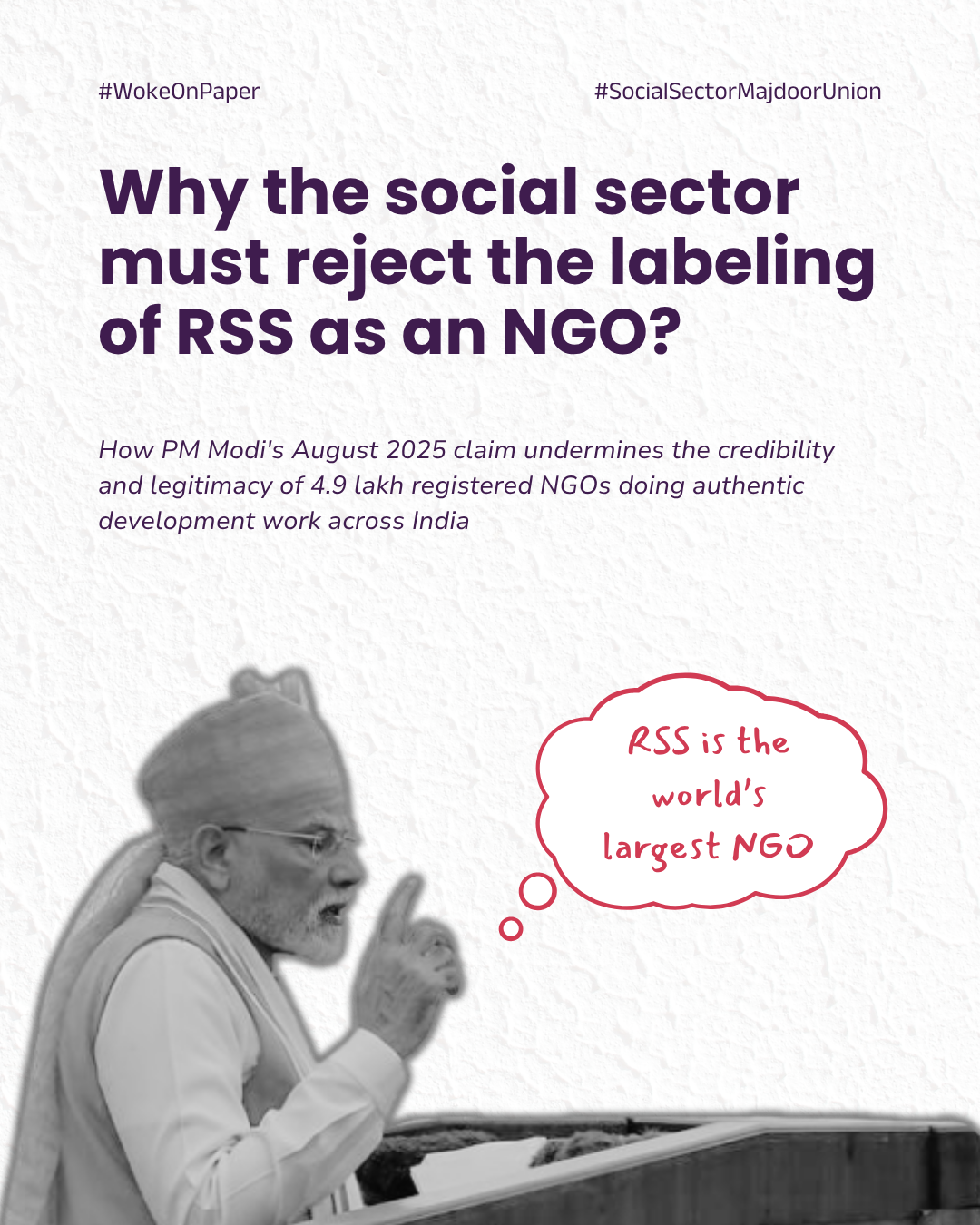
How a public claim that the RSS is the world's largest NGO undermines the credibility of India's 4.9 lakh registered nonprofits doing real development work.
The Claim
In August 2025, a remark describing the Rashtriya Swayamsevak Sangh (RSS) as the "world's largest NGO" put a spotlight on a basic but important question: what actually makes an organisation an NGO in India, and who gets to call themselves one?
What India's Registered NGOs Actually Do
India has close to 4.9 lakh registered NGOs, according to the government's own NGO portal, Darpan. They're registered under the Societies Registration Act, the Trusts Act, or the Companies Act — each carrying its own compliance and reporting requirements.
Between them, this network serves an estimated 400+ million Indians directly, working across education, healthcare, livelihoods, agriculture and rights — much of it in the remotest parts of the country, where public policy often struggles to reach. That reach has been built over years of sustained work, standing on the accountability and transparency mechanisms that let these organisations answer for how they operate.
Why Calling RSS an NGO Is Inaccurate
The RSS is around a century old, yet holds zero formal registration. It is not registered under the Societies Registration Act, the Trusts Act, or the NITI Aayog NGO registry.
Unlike registered NGOs, it does not publish annual reports, disclose its funding sources, file financial statements, or answer to any regulatory body.
When the head of government describes an unregistered, unaudited organisation as an NGO, it quietly erodes the years of legitimacy, accountability and public trust that registered NGOs have built through audits and transparency.
A Much Larger Network Than It Appears
Investigative reporting by The Caravan magazine has mapped more than 46 affiliated organisations making up what is known as the Sangh Parivar — frontal organisations registered separately, in ways that let each appear independently legitimate. Among them: Vidya Bharati (a registered education network), Seva Bharati (a registered social welfare body), the Bharatiya Kisan Sangh (agrarian mobilisation), the ABVP (a student wing), and the BJP itself, which shares cadre with the RSS — alongside 40-plus other sectoral organisations spanning trade unions, women's wings and youth wings. In total, Caravan's reporting counts more than 2,500 organisations directly tied to the RSS.
Source: "Unveiling the RSS: Exposing the Largest Far-Right Network in History," The Caravan, December 2025.
How the Network Stays Obscured
Researcher Felix Pal's organisational analysis draws a distinction between what he calls the "Cadre RSS" — the visible shakha system used for recruitment — and the "Managerial RSS": more than 2,500 affiliated organisations that are operational but largely hidden from public view.
This managerial layer runs on shared pracharaks (deployed organisers) moving across frontal organisations, a unified command structure running from the Sarsanghchalak down through joint general secretaries and pramukhs, and what Pal describes as "plausible deniability" achieved by registering each subsidiary individually.
Source: Felix Pal, "Similarity Heuristics in the Indian Far Right: How the RSS Obscures Its Operational Scale."
The Accountability Vacuum
The RSS's unregistered status creates real gaps: no financial transparency, since its funding sources stay outside public scrutiny; no regulatory oversight, since the state has no authority to monitor, audit or enforce compliance on it; and no beneficiary accountability, since there's no mechanism for affected communities to demand answers.
Its leadership structure compounds this — a central Sarsanghchalak with no democratic accountability, coordinating over 2,500 organisations without any formal governance framework binding them together.
A Constitutional Tension
The RSS openly pursues the idea of a Hindu Rashtra — a vision that sits outside, and often against, India's constitutional commitments to secularism, equality and pluralism.
Registered NGOs, by contrast, operate within that legal and ethical framework, bound by audits, transparency norms and rights-based principles. Equating the RSS with an NGO misrepresents both what an NGO legally is, and what it stands for.
Why the Distinction Matters
Equating NGOs with an organisation whose stated mission runs counter to constitutional values misrepresents civil society, and undermines the spirit in which real NGOs serve their communities.
As people who work in and around the sector, it's worth being precise about this distinction — not as a partisan point, but because the trust communities place in NGOs was built, slowly, through exactly the kind of accountability the RSS has never had to answer to.
WokeOnPaper is an independent satire media collective led by a small group of development practitioners. Through memes, stories and commentary, it reflects on the everyday absurdities of the social sector — nudging it towards becoming more honest, participatory and democratic.