Who Is a 100-Page Annual Report Really Accountable To?
Why most NGO annual reports read less like public accountability and more like donor-facing institutional storytelling.
The Law Assumes Accountability
Under Section 12A and 80G of the Income Tax Act, and as per the FCRA 2010, NGOs in India are required to publish their annual reports on their websites for compliance. The law assumes that a publicly available annual report makes an NGO accountable to the public eye.
But are NGOs truly accountable to the public?
Who the Report Is Really Designed For
When making NGO annual reports, you will often hear questions like: "How should it look?" Or "What will the donor think?" Or "Can we make the impact sound stronger?"
But no one ever asks: "How should this report be accountable to the community? Can they read it, understand it? Can the people we serve recognise their own reality in these pages?"
The report is almost always designed with the donor in mind. The tone, structure, proof points, visuals and financial framing are all built to reassure the funder that money was well spent. That already proves a lot.
Not Accountable to the Community
By design, nonprofits are not truly accountable to the communities they work with. The community cannot hold an NGO accountable for programme failures, or for data that does not reflect the reality in which they live.
They may be consulted. They may be surveyed. They may be photographed. But they rarely get the power to reject the NGO's version of success.
It proves that NGOs feel most accountable to the person or institution they receive money from. So the annual report becomes less a document for the community and more a performance of reliability for the funder.
They may be consulted. They may be surveyed. They may be photographed. But they rarely get the power to reject the NGO's version of success.
Evidence, Not Authors
An NGO's annual report is meant to create transparency for all parties involved. Its design should keep in mind the communities, staff, board members, donors, partners and the wider public.
But communities do not shape the narrative, approve the claims, or define what success should look like. The people most affected by the work are rarely the primary audience for an NGO's annual report. Even when communities appear in the report, they often appear as evidence, not as authors.
Why It Reads So Boring
This is part of a larger structure where upward accountability consistently dominates downward accountability. If the community cannot meaningfully challenge failed outcomes and inflated success claims, then the report is not neutral.
So who is the annual report really for? Not the community that has to live with the consequences. Not the people who should be able to say: "This did not work." It is mainly for those who fund, govern and legitimise the NGO.
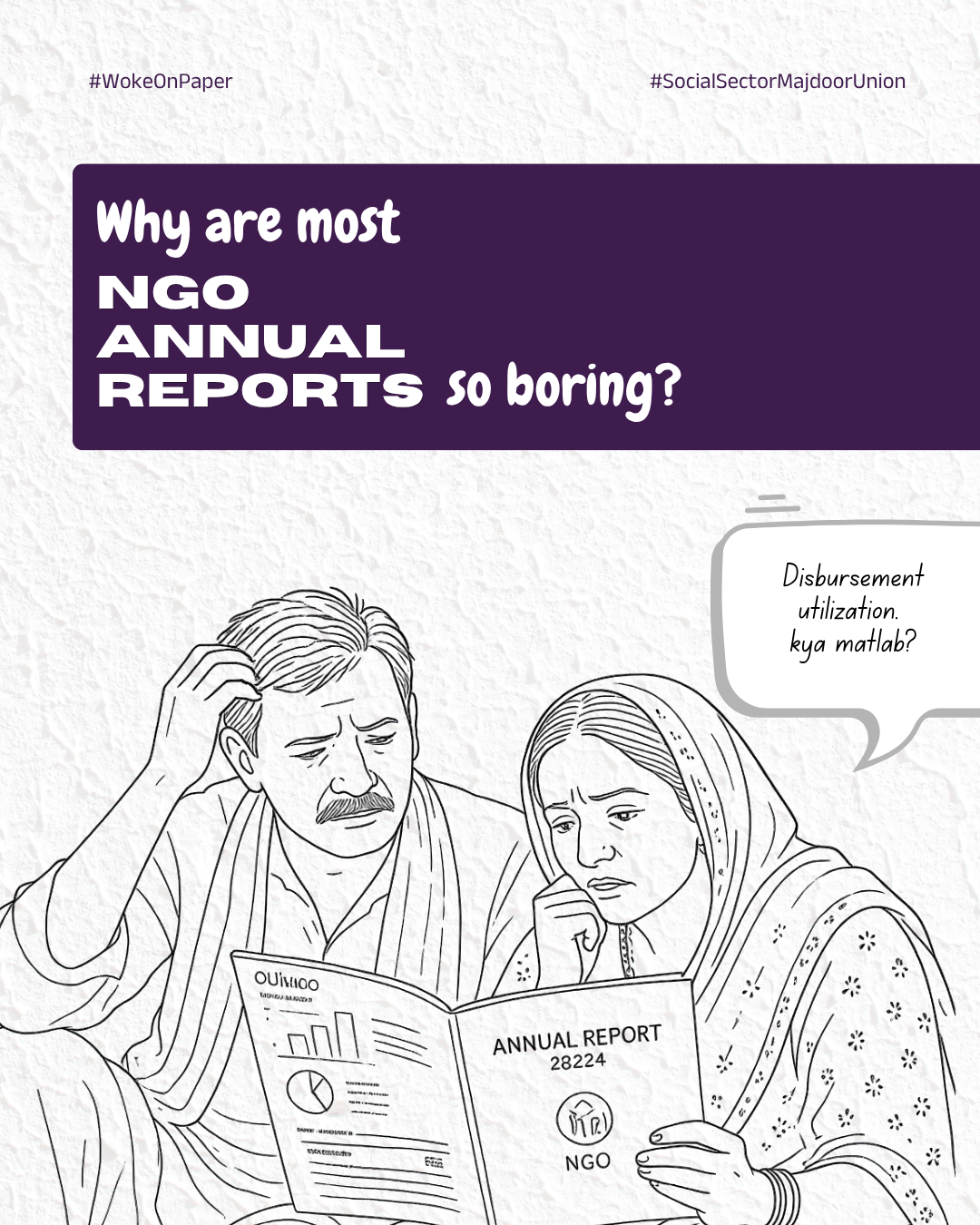
If NGOs designed their most "transparent" document around community judgment rather than donor comfort, their deepest accountability would be visible in the very document meant to prove otherwise. And that is precisely why most NGO annual reports are so boring to you — they were never made for you.
Most annual reports read less like public accountability and more like donor-facing institutional storytelling. They were never made for you.
WokeOnPaper is an independent satire media collective led by a small group of development practitioners. Through memes, stories and commentary, it reflects on the everyday absurdities of the social sector — nudging it towards becoming more honest, participatory and democratic.